


How to Choose the Right LED Wall Installation for Your Business
If you’ve walked into a modern lobby, sports bar, or corporate boardroom lately and stopped to stare at a giant, seamless screen glowing on the wall, you’ve already met the technology. A great LED wall installation can transform how a space feels – but choosing the right one is where many businesses get tripped up. Pick the wrong specs and you either overspend by thousands or end up with a display that looks fuzzy from where people actually stand.
The good news? Once you understand a few core concepts, the decision gets much simpler. In this guide, we’ll cover how to choose the right LED wall for your business, what “pixel pitch” really means, and the factors that matter far more than the flashy numbers on a spec sheet.
What Is an LED Wall, Exactly?
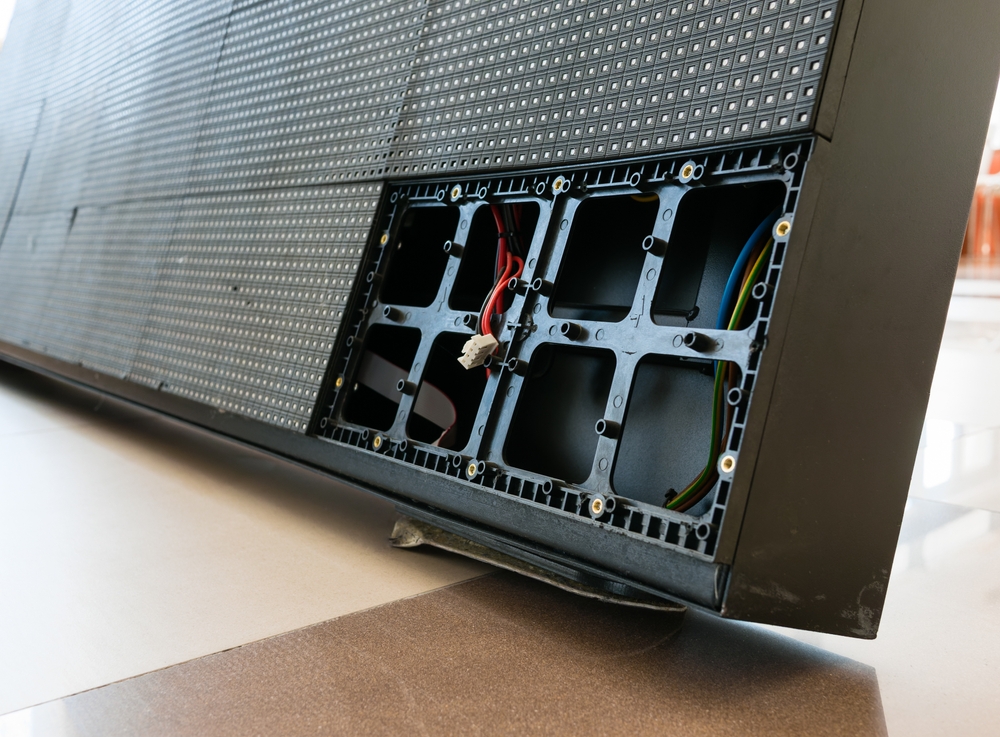
An LED wall is a large display built from many small panels – called modules or cabinets – that tile together to form one continuous, bezel-free image. Each panel is packed with tiny light-emitting diodes (LEDs) that act as individual pixels, producing their own light and color. Because there are no seams between panels, the whole surface reads as a single screen, no matter how big it gets.
That’s the key difference between an LED wall and a video wall made from several TVs pushed together. Traditional displays have visible borders where the screens meet; LED walls don’t. They can also be built to almost any size or shape, which is why you’ll see them wrapping around corners, filling entire walls, or forming custom layouts.
If you’re curious about the underlying science, the U.S. Department of Energy has a clear explainer on how LED technology produces light: an electrical current passes through a semiconductor to create bright, efficient, long-lasting light.
Why Businesses Are Moving to LED Walls
LED walls used to be reserved for stadiums and Times Square – not anymore. Prices have dropped, panels have gotten thinner, and businesses of all sizes now use them for everything from digital signage to immersive brand experiences.
A few reasons they’ve become so popular:
They’re bright. Unlike a projector that washes out in a sunny room, an LED wall stays vivid even in high-traffic, well-lit spaces – ideal for lobbies, retail floors, and hospitality venues where you can’t control the lighting.
They’re efficient and durable. LEDs are widely considered the most energy-efficient lighting technology available today. According to ENERGY STAR, LED products produce light far more efficiently than older technologies and tend to last for years. Rather than “burning out” all at once, LEDs slowly dim over a very long lifespan.
They’re flexible. Because they’re modular, LED walls can be sized to fit your space instead of forcing you to design around a standard screen dimension.
They command attention. A well-designed LED wall creates a focal point traditional displays can’t match – exactly why they work so well for branding and live content.
The One Spec That Matters Most: Pixel Pitch
Here’s the single most important term to understand before you buy, and the one most people have never heard of: pixel pitch.
Pixel pitch is the distance, measured in millimeters, between the center of one LED pixel and the center of the next. A smaller pixel pitch packs the pixels closer together for a sharper, higher-resolution image – but it costs more. A larger pixel pitch spreads them out, lowering both resolution and price.
You’ll usually see it written with a “P” and a number: a “P2” wall has a 2mm pitch, a “P6” wall has 6mm. The lower the number, the finer the detail.
So should you just buy the smallest pixel pitch you can afford? Not at all – and this is where matching pitch to viewing distance saves you real money.
How to Match Pixel Pitch to Viewing Distance
The most practical way to choose pixel pitch is to think about how far away your audience will actually be standing. A widely used industry rule of thumb – sometimes called the “10x rule” – is to multiply the pixel pitch in millimeters by 10 to estimate the minimum comfortable viewing distance in feet. So a 2mm (P2) wall looks crisp from about 20 feet away, while a 10mm (P10) wall needs viewers to be roughly 100 feet back before the image reads as seamless.
Keep in mind this is an approximation, not a precise law – the comfortable distance also depends on content, eyesight, and lighting. The AV trade association AVIXA offers a deeper breakdown of how to choose the right pixel pitch if you want the underlying math.
The takeaway is simple: if people view your screen from far away, a larger (and cheaper) pixel pitch works beautifully. If they’ll be up close – reading text in a boardroom, say – you’ll want a finer pitch. Paying for an ultra-fine pitch on a display nobody stands near is one of the most common and expensive mistakes we see.
A Quick Pixel Pitch Cheat Sheet
Here’s a general guide to how pixel pitch tends to map to different environments. Treat these as approximate starting points, not hard rules:
- P0.9-P1.5 (very fine): Boardrooms, control rooms, and close-up displays viewed within roughly 10-15 feet.
- P1.8-P2.5 (fine): Corporate lobbies, retail interiors, and conference spaces viewed from about 15-25 feet.
- P3-P4 (standard): Larger rooms, auditoriums, and venues where the audience is around 30-40 feet away.
- P6-P10 (coarse): Outdoor signage, stadiums, and large public spaces viewed from 60 feet or more.
Brightness, Content, and Space: The Other Factors
Pixel pitch gets most of the attention, but a few other factors will decide whether your LED wall looks great in the real world.
Brightness and Ambient Light
A screen that looks stunning in a dim showroom might look washed out in a room full of windows. Brightness is measured in “nits,” and displays destined for bright or sunlit spaces need far higher brightness than those in controlled indoor lighting. It’s worth checking how much natural and artificial light hits the wall through the day, so the display stays vivid rather than disappearing when the sun comes out.
Indoor vs. Outdoor
Indoor and outdoor LED walls are built differently. Outdoor units need weatherproofing, much higher brightness to fight sunlight, and typically a larger pixel pitch because viewers stand farther back. Indoor walls prioritize fine detail and color accuracy. Using an indoor panel outside – or an outdoor panel in a boardroom – is a recipe for wasted money.
Content Type
What are you actually going to show? Detailed content – small text, spreadsheets, live data, crisp 4K video – demands a finer pixel pitch to stay legible. Big, bold graphics, logos, or ambient motion can look fantastic on a coarser, more affordable pitch. Matching the display to your content keeps you from overpaying for resolution nobody will notice, or under-buying and ending up with mushy text.
Don’t Overlook Integration and Support
A screen is only as good as the system running it – and this is the part buyers tend to forget, where a project quietly succeeds or fails.
Your LED wall needs to connect cleanly to your content sources, control systems, and existing AV gear. In a meeting space, it should tie into your conference room AV setup so presenters can push content to the screen without wrestling with cables and adapters. In a venue, it might need to sync with lighting, audio, and scheduling so everything runs from one interface.
That’s why LED walls are rarely a standalone purchase. They’re one piece of a larger commercial AV system, and they perform best when everything is planned to work together from the start – cabling, mounting structure, power, heat management, and control all accounted for before installation day rather than discovered halfway through.
And then there’s the long game: service and support. Modules can occasionally need attention, and content systems need updates. A partner who sticks around after the install – rather than powering it on and disappearing – is what protects your investment for years.
How Much Does an LED Wall Installation Cost?
This is the question everyone asks, and the honest answer is: it depends – a lot. We won’t quote a specific figure here, because real pricing swings dramatically based on the factors we’ve covered. The biggest cost drivers are pixel pitch (finer pitches use far more LEDs and cost more per square foot), total screen size, indoor versus outdoor rating, mounting complexity, and integration work.
Two walls of identical dimensions can differ substantially in price based on pixel pitch alone. The best way to get a number you can plan around is a proper site assessment that matches the specs to your space and goals. Be cautious of any quote handed to you before someone understands your viewing distances and environment.
Choosing the Right AV Integrator
Maybe the most important decision isn’t the technology at all – it’s who you hire to install it. The same panels can look spectacular or mediocre depending on how well they’re planned, aligned, and calibrated.
A strong AV integrator starts with your space and your goals, not a product catalog. They’ll ask how far away people stand, what you want to display, and how bright the room gets, then handle the structural, electrical, and network details – and be there for service down the road.
At Briggs AV Solutions, we design and install LED wall installations for commercial spaces across Middle Tennessee, with a focus on displays that hold up under constant, real-world use. Our approach is to right-size the technology to your space – maximum visual impact without overspending on specs you don’t need.
Planning Your LED Wall Installation
Choosing the right LED wall installation comes down to a handful of practical questions: How far away will people stand? How bright is the space? What will you display? Match your pixel pitch to your viewing distance, lean on an experienced integrator for the details, and you’ll end up with a display that looks incredible and makes sense for your budget.
If you’re weighing an LED wall for your business and want a straight answer on what actually fits your space, we’re happy to help you think it through. Reach out through our contact page, and we’ll help you plan a display built for impact and built to last.
Frequently Asked Questions
What is the best pixel pitch for an LED wall? There’s no single “best” pixel pitch – the right one depends entirely on how far your audience stands from the screen. As a rough guide, close-up spaces like boardrooms often use P0.9 to P1.5, indoor lobbies and retail spaces work well with P1.8 to P2.5, and outdoor or large-venue signage can use P6 to P10. Choosing a finer pitch than your viewing distance requires just adds cost with no visible benefit, so match the spec to your actual space.
Are LED walls better than projectors? For many commercial settings, yes – especially bright ones. LED walls stay vivid in well-lit rooms where projectors tend to wash out, they don’t need a throw distance, and they last a long time with only gradual dimming. That said, projectors can still make sense for very large images in controlled, darker environments or for budget-conscious temporary setups. The right choice depends on your room’s lighting, its size, and how the display will be used day to day.
How long do LED walls last? LED walls are built for longevity. Rather than burning out suddenly, the LEDs slowly lose brightness over a very long operating life – commonly rated in the tens of thousands of hours. Because the panels are modular, individual sections can usually be serviced or replaced without swapping the entire wall. Lifespan does depend on how many hours a day the display runs and how well it’s maintained, which is one more reason ongoing support is worth planning for.
Can an LED wall be installed outdoors? Yes, but you need panels specifically rated for outdoor use. Outdoor LED walls include weatherproofing, run at much higher brightness to stay visible in sunlight, and usually use a larger pixel pitch since viewers stand farther away. Installing an indoor-rated panel outside will lead to brightness and durability problems, so it’s important to specify the right product for the environment right from the start.
Do I need special wiring or infrastructure for an LED wall? Usually, yes. An LED wall needs adequate power, data cabling, a solid mounting structure, and often heat management – all planned before installation. It also has to connect to your content sources and control systems. That’s why an LED wall is best handled as part of a broader commercial AV plan rather than a standalone add-on. Getting the infrastructure right upfront prevents headaches later and keeps the whole system reliable.