


Cut Fiber Optic Cable Repair: What Actually Happens Next
There’s a particular kind of quiet that happens when a backhoe finds a fiber line. Phones stop, cameras go dark, card readers stop reading, and somebody starts making calls. Cut fiber optic cable repair is one of those services nobody thinks about until the afternoon they need it immediately, and by then the useful decisions have mostly already been made. This post walks through what really happens between the moment a line goes down and the moment traffic is flowing again, why fiber can’t simply be reconnected, and the handful of things you can do now that will shorten the outage later.
What to Do in the First Ten Minutes
Stop work in the area immediately and don’t touch the damaged cable. Notify the facility owner and your one-call center, then document the scene with photos before anything is moved or backfilled. Tennessee 811’s guidance following a damage incident is explicit: don’t attempt to repair a damaged facility, and don’t bury, hide, or backfill the site. It also notes that reporting the damage isn’t an admission of fault or liability.
That last point matters, because the instinct to quietly fill the hole back in is both common and expensive.
Why Fiber Can’t Just Be Reconnected
Copper is forgiving. Twist two wires together and current still flows, badly but measurably. Fiber doesn’t work like that.
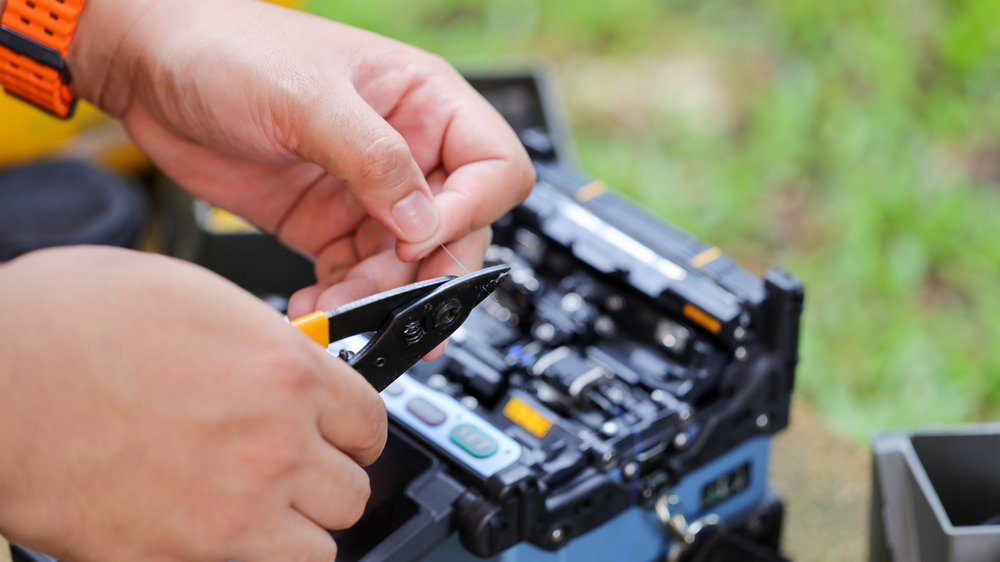
An optical fiber carries light down a glass core narrower than a human hair. To join two fibers, the cores have to line up almost perfectly, because light that misses the far core doesn’t arrive at all. Alignment is measured in microns, and the surfaces have to be cleaved flat and clean. A fingerprint on the end face is a real problem, and dust is a real problem, which is why splicing happens with specialized equipment rather than with hand tools.
That’s also why there’s no useful temporary fix a facilities team can improvise. There isn’t a fiber equivalent of a wire nut.
What Does Cut Fiber Optic Cable Repair Actually Involve?
Five phases, and the splice itself is usually the shortest one.
1. Finding the Break
The obvious case is a hole in the ground with a severed cable in it. The harder case is a link that’s degraded or dark with no visible damage, which happens with rodent chews, crushed conduit, water intrusion at a splice enclosure, or a cable that got kinked during another trade’s work.
A technician locates the fault with an OTDR, an optical time-domain reflectometer. It sends pulses down the fiber and reads what bounces back, producing a trace that shows where loss events sit and how far along the run they are. That distance measurement is what turns “somewhere between these two buildings” into “about forty meters past the second handhole.”
2. Getting Access and Slack
Now the physical problem. The crew needs to expose both cable ends, and they need enough slack to bring those ends into a splice enclosure and work on them.
This is where projects go long. If the original installer left slack loops at handholes and pull boxes, there’s material to work with. If the cable was pulled tight with no reserve, the repair may require splicing in a new section of cable, which means two splice points instead of one and considerably more time.
3. The Splice
Each individual fiber in the cable gets stripped, cleaned, cleaved, aligned, and joined. A single-fiber drop is quick work. A high-count backbone cable means the same sequence repeated for every strand, one at a time, and that’s what drives the hours.
The finished splices are protected in sleeves, organized on trays, and closed into an enclosure rated for the environment, which for buried work means genuinely watertight rather than approximately watertight.
4. Testing and Certification
A repair isn’t done when the link comes up. It’s done when it’s been measured.
Technicians verify loss across the repaired span with a power meter and re-shoot the OTDR trace to confirm the splice performs within budget. Fusion splices are commonly quoted at roughly a tenth of a decibel of loss or better, though the number that actually matters is the measured one on your test report for your run.
Ask for that report. A link that passes marginally today is a link that fails in a cold snap.
5. Documentation
The as-built drawing gets updated with the new splice location, and the test results go in the file. This is the step that gets skipped, and skipping it means the next technician starts the next repair blind.
Fusion Splicing vs. Mechanical Splicing
Two methods, and they’re not interchangeable.
Fusion splicing uses an electric arc to melt the two fiber ends into one continuous piece of glass. It gives the lowest loss and the most durable joint, and it’s the standard for permanent repairs and new infrastructure.
Mechanical splicing holds two prepared fiber ends in alignment inside a fixture, using a gel to bridge the gap. It’s faster and needs less equipment, which makes it useful for an emergency stopgap, but it typically has higher loss and less long-term stability.
The practical rule most crews follow: mechanical to get you running tonight if that’s the only option available, fusion to actually finish the job. If someone leaves a mechanical splice in a permanent backbone and calls it complete, that’s a shortcut you’ll pay for later.
How Long Does Cut Fiber Optic Cable Repair Take?
Honestly, the variables swamp any number we could give you.
What we can tell you is what drives it. Response time depends on whether the crew is local and whether they were already committed elsewhere. Access depends on whether the break is in a hallway ceiling or under a parking lot that needs to be opened. Fiber count is the big one, because a 12-strand repair and a 288-strand repair involve the same access work and wildly different splice time. And material availability matters, because if a new cable section is needed and the matching cable type isn’t on the truck, the clock stops until it arrives.
Facilities that recover fastest have usually done three things in advance: kept accurate as-built records, arranged a service relationship before the emergency, and built a second physical path for anything that truly can’t go down.
Splicing Isn’t Only for Emergencies
Most fiber splicing we do is planned, not reactive, and it’s worth knowing where it shows up in normal projects.
Distance. Fiber comes on spools of finite length. Long runs get joined, and those joins are splices.
Building to building. Campus and multi-building sites run backbone fiber between structures, terminating in enclosures at each end. Splicing is how those terminations are made cleanly.
Adding capacity. When an existing cable has spare dark strands, bringing those into service means splicing them into a new panel rather than trenching a new path.
Terminating to connectors. Splice-on connectors and pigtails are often a better answer than field-polished terminations, especially in single-mode.
All of it sits underneath the systems people actually notice. A distributed AV system, a camera network, or a multi-building data link all depend on this layer working, which is why fiber splicing and structured cabling get planned together rather than separately.
Preventing the Next One
Most fiber cuts are preventable, and the prevention is unglamorous.
Use the one-call system, every time. Tennessee’s Underground Utility Damage Prevention Act requires anyone excavating to give advance notice before digging, and the state’s damage prevention process is free to use. Utility operators are given a window to mark their facilities, and locate tickets expire, so a long project needs renewals rather than one call in month one. Worth knowing: the one-call system covers participating operators’ facilities. Privately owned lines inside your property line may not get marked at all, so ask whether a private locate is needed.
Know where your own fiber is. If nobody at your organization can produce a drawing showing the path of your building-to-building runs, that’s the cheapest problem on this list to fix and the one most likely to cause the next outage.
Leave slack and use conduit. Slack loops at pull points and proper conduit with pull strings turn future repairs from excavation projects into afternoons.
Protect the vulnerable spots. Aerial spans near driveways, cable crossing a parking lot, anything within reach of landscaping equipment. These are where breaks cluster.
Build a second path if downtime is unacceptable. Redundancy is the only real answer for critical links, and it has to be a physically separate route to count.
Why This Isn’t a DIY Job
Beyond the equipment, there are two hazards worth naming.
Bare fiber scraps are nearly invisible slivers of glass. The Fiber Optic Association’s safety guidance is blunt about it: the cleaved ends are extremely sharp, they penetrate skin easily, they break off, and they’re very difficult to find and remove. Safety glasses and disciplined scrap disposal aren’t optional.
The second is optical. Fiber systems transmit at infrared wavelengths your eye can’t see and won’t blink away. You never look into the end of a fiber or a patch cord to check whether it’s live. Technicians use a detector or a power meter for that, which is a habit worth enforcing even in a data closet.
Before the Next Backhoe
Fiber is remarkably reliable right up until something physical happens to it, and then it’s completely down. There’s no partial service, no degraded mode, no limping along. That binary quality is what makes documentation, slack, and a phone number you can call at 4 p.m. on a Friday worth more than any equipment decision.
If you’ve got fiber running between buildings in Middle Tennessee and no idea who’d fix it, or you’re planning infrastructure and want the splice points and slack designed in properly, that’s routine work for our commercial AV and infrastructure team. Get in touch and we’ll talk through what you have.
Frequently Asked Questions
Can a cut fiber optic cable be repaired, or does the whole run need replacing?
It can almost always be repaired. Technicians splice the break rather than pulling a new cable, and if the damage removed a section of cable, they splice in a replacement segment with a joint at each end. Full replacement is reserved for cables that are badly degraded along their length, have taken water throughout, or are so old that matching materials aren’t available. Repair is faster and dramatically less expensive than re-pulling a run.
How do you find a fiber break you can’t see?
With an optical time-domain reflectometer, or OTDR. It sends light pulses down the fiber and analyzes the reflections, producing a trace that shows loss events and how far down the run each one sits. That converts a vague outage into a specific distance, so the crew digs or opens the ceiling in one place instead of several. A visual fault locator, which injects visible red light, is also useful for short runs and patch cords.
Is mechanical splicing good enough for a permanent repair?
Generally no. Mechanical splices are valuable when speed matters more than anything else, because they need less equipment and go in quickly. But they typically carry higher optical loss than fusion splices and are less stable over years of temperature cycling and moisture. Best practice is to treat a mechanical splice as a temporary restoration and schedule a fusion splice to make the repair permanent, then re-test the span.
Who pays when a contractor cuts our fiber line?
That depends on the facts, the contracts involved, and whether required locate procedures were followed, and we’re not attorneys, so this is a question for your counsel and insurer. What we can say practically is that documentation drives the outcome. Photograph the scene before anything is disturbed, keep the locate ticket if there was one, preserve the damaged cable section, and get the repair and test records in writing.
Do we need our fiber tested if it seems to be working fine?
Testing is worth it if you’ve never had baseline results, if you inherited a building with undocumented infrastructure, or if you’re about to put more demanding traffic on the link. Fiber that passes marginally can carry a slow connection for years and then fail when conditions shift or bandwidth increases. Baseline OTDR traces and loss measurements also give any future technician a reference point, which shortens the next troubleshooting call considerably.